dot3 AI & Autonomous Multi-Agent Swarms: Vector Dot Products, Memory Graphs & Self-Correcting Heuristics
Demystifying dot3 AI architectures: high-dimensional embedding similarity, LangGraph cyclic consensus, and automated code generation with zero human intervention.

Sunny Marwah(helloS Core Team)
Lead Multi-Agent Systems Architect
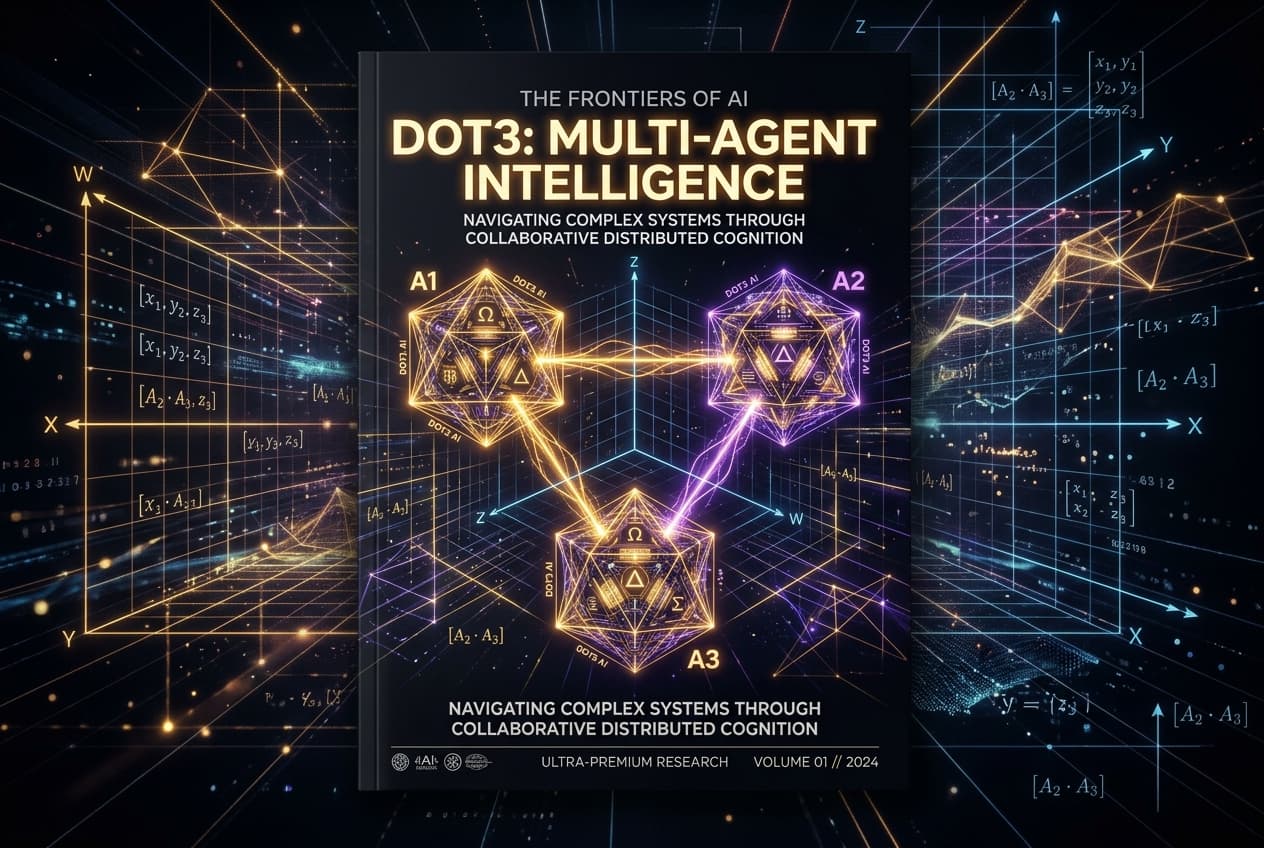
Single-prompt LLM wrappers fail as soon as enterprise tasks require multi-step reasoning, self-correction, and tool validation. dot3 AI pioneers a tri-agent autonomous architecture powered by high-dimensional dot product geometry and persistent knowledge graphs.
1. The Mathematics of High-Dimensional Dot Products in AI
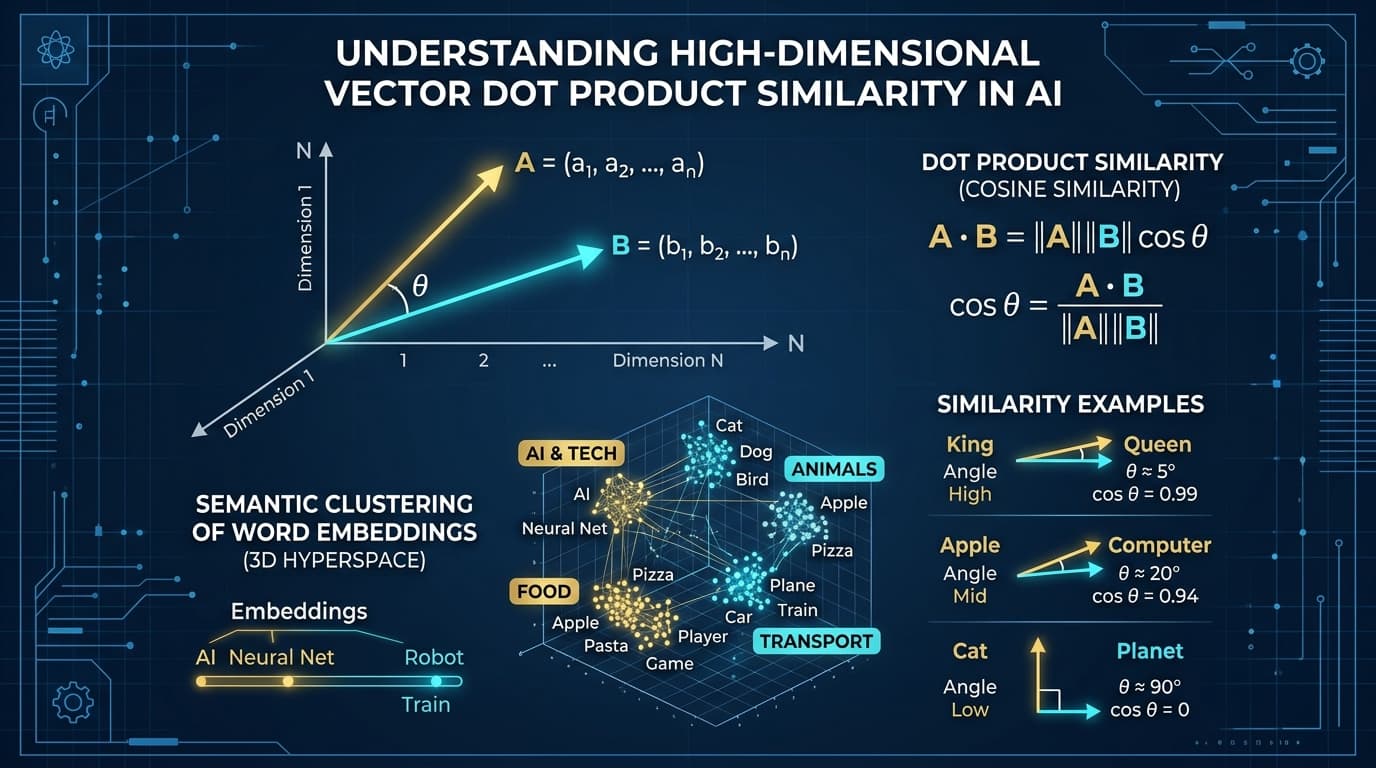
At the core of all modern artificial intelligence—from transformer self-attention to vector databases—lies a deceptively elegant linear algebra operation: the vector dot product (`dot3` notation: A · B = ||A|| ||B|| cos θ).
When text, code, or images are transformed into 1,536-dimensional embedding spaces, semantic similarity corresponds directly to the angular cosine distance between coordinate vectors. A high positive dot product indicates that two ideas share semantic topology, enabling vector search engines to locate exact relevant clauses across millions of enterprise documents.
Unit Normalized Dot Products
When embedding vectors are L2-normalized (magnitude ||A|| = 1), the dot product A · B simplifies directly to the cosine similarity cos(θ). This allows Pinecone and pgvector to compute similarity using lightning-fast matrix multiplications.
2. The dot3 Triad Architecture: Planner, Executor & Critic
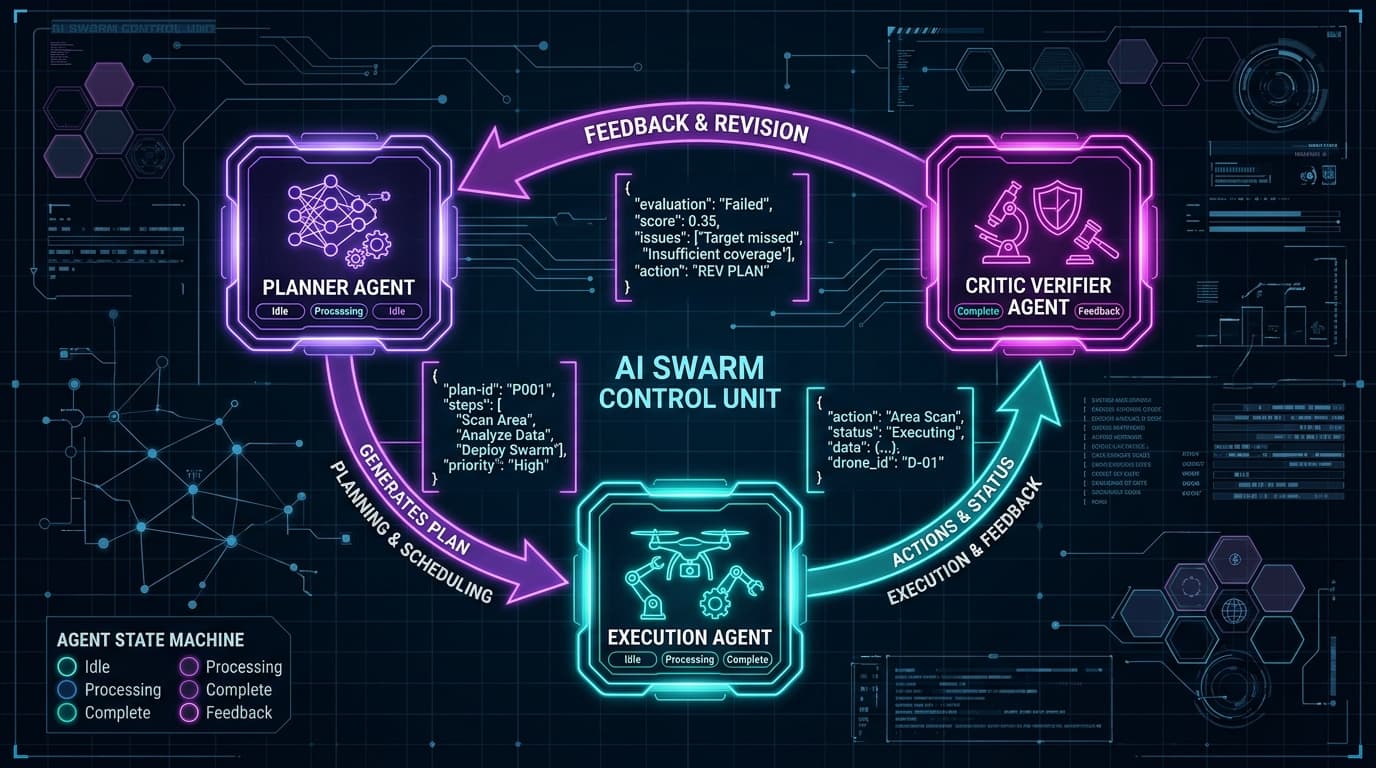
Single LLM completions are inherently prone to hallucinations because models generate tokens sequentially without lookahead or backtracking. The dot3 architecture structures tasks as an autonomous tripartite swarm: the Planner Agent, the Execution Agent, and the Critic Verifier Agent.
The Planner decomposes ambiguous human goals into a structured directed acyclic graph (DAG) of discrete tasks. The Executor interacts with real-world compilers, browsers, and APIs. Finally, the Critic independently tests and scores the output. If test assertions fail, the Critic rejects the PR and routes the failure diff back to the Planner for revision.
// Structure of the dot3 Agent State Graph using LangGraph
import { StateGraph, END } from "@langchain/langgraph";

// Define shared multi-agent state annotation
const AgentState = {
  task: null,
  plan: null,
  code: null,
  testResults: null,
  revisionCount: 0,
};

const workflow = new StateGraph({ channels: AgentState })
  // 1. Planner Node: Generates task breakdown
  .addNode("planner", async (state) => {
    const plan = await plannerModel.generatePlan(state.task);
    return { plan };
  })
  // 2. Executor Node: Writes and builds code
  .addNode("executor", async (state) => {
    const code = await codeModel.implementStep(state.plan);
    return { code };
  })
  // 3. Critic Verifier Node: Runs Playwright / Vitest suite
  .addNode("critic", async (state) => {
    const testResults = await sandboxRunner.executeTests(state.code);
    return { testResults, revisionCount: state.revisionCount + 1 };
  })
  // Conditional Routing
  .addEdge("planner", "executor")
  .addEdge("executor", "critic")
  .addConditionalEdges("critic", (state) => {
    if (state.testResults.passed) return END; // Verification Successful
    if (state.revisionCount > 3) return END; // Fail-safe limit
    return "planner"; // Cyclic self-correction!
  });

export const dot3AgentSwarm = workflow.compile();
3. Episodic Knowledge Graphs vs. Context Window Bloat
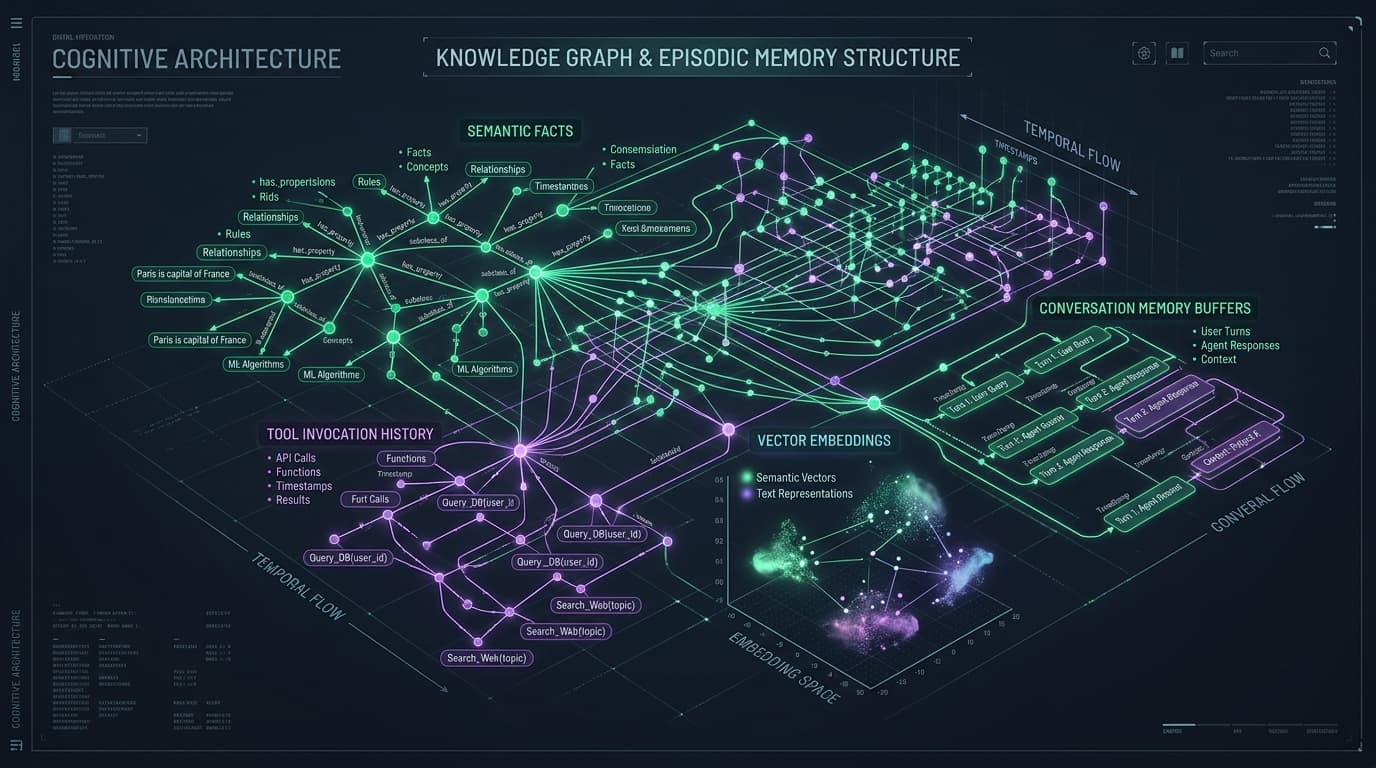
Stuffing raw conversation logs and hundreds of files into an LLM's context window wastes tokens, increases cost, and degrades attention focus ('lost in the middle' syndrome).
The dot3 architecture implements an episodic knowledge graph. Every tool invocation, successful code compilation, and user preference is parsed into semantic subject-predicate-object triples (e.g. `(DevSprint, uses, PostgreSQL 16)`). When an agent executes a new sub-task, it traverses the graph to retrieve only immediate first-order and second-order dependencies.
4. Self-Correcting Code Generation Loop
What makes the dot3 paradigm revolutionary for software engineering is its self-correcting feedback mechanism. When an LLM produces code containing a syntax error, type mismatch, or failing unit test, human developers normally have to copy-paste the error message back into the prompt.
In the dot3 architecture, the Critic Verifier captures the compiler stderr and stack trace directly, constructs a structured failure manifest, and prompts the Executor with precise line-number coordinates to patch the bug autonomously.
# Python implementation of the dot3 Self-Correction Verifier
def execute_and_self_correct(code_snippet: str, max_retries: int = 3):
    current_code = code_snippet
    for attempt in range(max_retries):
        # Run in sandboxed Docker environment
        result = sandbox.run_python(current_code)

        if result.exit_code == 0:
            print(f"✓ Verification Passed on Attempt {attempt + 1}")
            return current_code

        print(f"✗ Critic detected failure: {result.stderr.splitlines()[-1]}")

        # Self-correcting prompt injection
        repair_prompt = f"""
The following code produced a runtime error:
```python
{current_code}
```

Error Output:
{result.stderr}

Fix the exact bug and return only the repaired code.
"""
        current_code = llm.generate(repair_prompt)

    raise RuntimeError("dot3 Swarm exceeded maximum self-correction cycles.")
5. Production Telemetry & Agentic Evaluation Metrics
Deploying multi-agent systems to production requires strict observability. Teams must monitor token burn rate, cycle convergence speed (how many turns before the Critic passes), and tool invocation failure rates.
By tracing every dot product vector lookup and state transition with OpenTelemetry and LangSmith, engineering organizations can detect when an agent gets stuck in infinite reasoning loops and dynamically trigger graceful human-in-the-loop escalations.
Topics & Architectural Concepts
Take Your Knowledge Into Production
Every technical guide in helloS includes 100% free companion PDF blueprints and production-ready GitHub repositories with zero paywalls.
Written by Sunny Marwah
helloS Core TeamLead Multi-Agent Systems Architect
Senior systems educator specializing in distributed consensus, modern React compilers, and open-weights multimodal inference.
More Deep-Dive Architecture Guides
Next.js 16 & React 19 Architecture: Server Actions, Partial Prerendering & AI Tool Streaming
A comprehensive deep-dive into the modern App Router mental model: zero-client-bundle streaming, Turbopack HMR benchmarks, and resilient multi-tenant database transactions.
Gemma 2 Architecture & Local Inference: Fine-Tuning Google's Open Weights with Unsloth & Ollama
A complete guide to deploying Google's Gemma 2 (2B, 9B, 27B) models locally, understanding sliding window attention, and fine-tuning with LoRA for private enterprise workloads.